MCA Leads: Types, Costs & How to Buy Safely (2027 Guide)
By MD Abdul Latif, CEO at MCA Leads World | Last updated: 20-Oct-2026
MCA leads are what a merchant cash advance business runs on. But the market for them is full of vague labels. You might buy a batch of “exclusive” merchant cash advance leads and find out three other shops already called the same owner. Or you might pay for “verified” leads and learn that the phone numbers are a year old.
This guide shows you how to buy MCA leads without getting burned. First, you’ll see every lead type and what each one costs in 2026. Next, you’ll learn how to work out your cost per funded deal. Then you’ll get the compliance basics and a 30-day test you can run on any provider before you spend big. It’s written for MCA funders, ISOs, brokers, and unsecured loan and equipment finance providers.
Key facts about MCA leads (2026)
Definition: MCA leads are records of small business owners who want, or might qualify for, a merchant cash advance or other fast working capital.
Main types: real-time exclusive, live transfer, appointment, aged, UCC and trigger, and application data.
Typical cost: from a few cents for an aged record to about $40–$200 or more for an exclusive real-time lead, and $75–$150 or more for a live transfer (based on 2026 published vendor prices).
Best number to watch: cost per funded deal, not cost per lead.
Compliance: get consent for calls and texts, check do-not-call lists, and learn your state’s rules before you contact any lead.
Best first step: test any provider with a small batch before you scale.
What Are MCA Leads?
MCA leads are records of small business owners who want, or might qualify for, a merchant cash advance (MCA) or other fast working capital. A merchant cash advance is money a business gets up front and pays back from its future sales. It usually funds faster than a bank loan, and it’s easier to qualify for.
A lead can be many things. It might be a simple web form with three fields. It might also be a full application with bank statements attached. That’s why two vendors can both sell “MCA leads” at very different prices.
The owners behind these leads usually run businesses where cash is tight: restaurants, shops, trucking companies, contractors, salons and auto repair. Picture a restaurant whose walk-in cooler died on a Friday. Or picture a landscaper who needs a second truck before spring. These owners care more about speed than the lowest rate.
Most funders also want a minimum amount of money coming into the account each month, often around $10,000–$15,000. So an honest owner below that line can still waste your time. Ask every vendor whether it checks revenue first.
Types of MCA Leads Compared
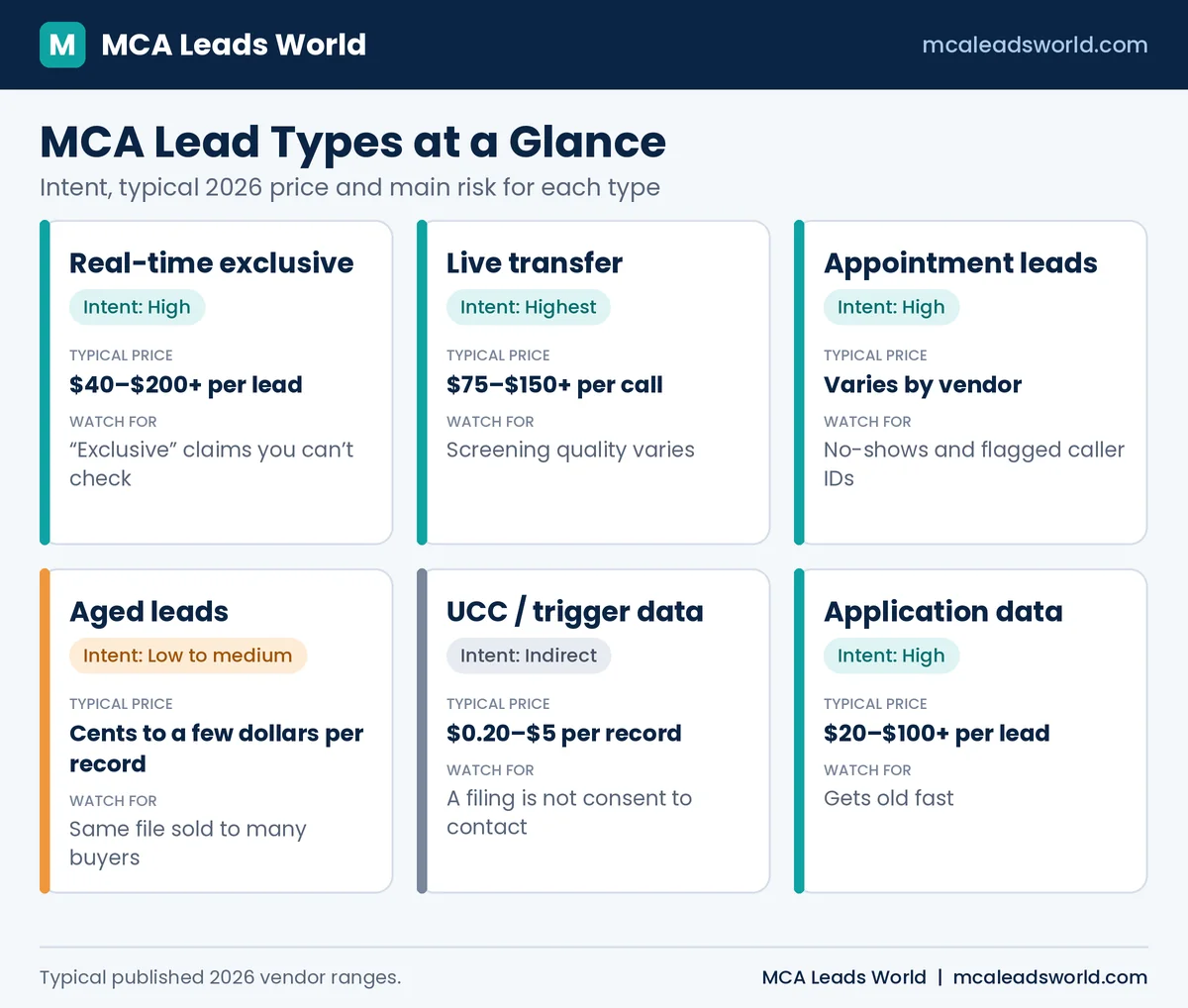
There are six main types of MCA leads: real-time exclusive, live transfer, appointment, aged, UCC and trigger, and application data. They differ in three ways: how interested the owner is, how many buyers get the lead, and the price. No single type is best. The best MCA leads for you are the ones that fund at a cost your team can profit from. That depends on how many people you have and how fast they can act. Here’s how the types compare.
| Lead type | Intent | Shared? | Best for | Main risk |
|---|---|---|---|---|
| Real-time exclusive | High (owner reached out within minutes) | Sold to one buyer, if the vendor is honest | Teams that can call within minutes | Price; “exclusive” claims you can’t check |
| Live transfer | Highest (owner is on the phone) | Usually one buyer | Strong closers who don’t want to prospect | Cost per call; screening quality varies |
| Appointment lead | High (callback time booked) | Usually one buyer | Teams that want a steady calendar | No-shows; blocked or flagged caller IDs |
| Aged lead | Low to medium (asked weeks or months ago) | Often sold to many buyers | High-volume dialers and SMS or email | Same file sold to many buyers; dead numbers; tired owners |
| UCC / trigger data | Indirect (public financing filings) | Public record, so anyone can buy it | Outbound teams chasing renewals and refinances | A filing is not consent to contact |
| Application data | High (owner gave details) | Varies; ask how many buyers | Teams that can underwrite fast | Gets old fast |
Exclusive and Real-Time MCA Leads
Real-time MCA leads come from an owner who just filled out a form or called in. Vendors also call these fresh MCA leads. Usually that means the owner reached out minutes or hours ago. However, every vendor defines “fresh” differently, so ask for the exact time window. These leads work because the owner needs money right now. Also, they may not have talked to anyone else yet.
Exclusive MCA leads go to one buyer only. But “exclusive” has no legal meaning. One vendor might mean one buyer forever. Another might mean one buyer for the first hour. So ask how many companies get each lead, and for how long. Get the answer in writing.
Live Transfer Leads
With a live transfer, an agent talks to the owner first. The agent checks that the owner is real, interested and a good fit. Then the agent connects the call to your closer. This option costs the most per lead. In return, you skip the prospecting. Some providers only charge for calls that meet agreed rules, so it’s worth asking.
Appointment Leads
Appointment leads are like live transfers, with a delay. A telemarketer talks to the owner and books a time for your team to call back. That way, you work from a calendar instead of a long call list. The downside is no-shows. Also, spam-flagged caller IDs can hurt your results.
Aged MCA Leads
Aged leads are real-time leads that nobody turned into a deal while they were fresh. Some buyers skip them. Still, an owner who asked for funding six to twelve months ago already knows what an MCA is. And things change. A restaurant that said “not now” in March might be dealing with a broken walk-in cooler by September.
The risk is how many buyers got the same file. If a vendor sold it to forty shops, that owner’s phone has been ringing for months.
UCC and Trigger Leads
UCC leads come from UCC-1 filings. These are public records a lender files when it takes a claim on a business’s assets. A filing can show that a business took financing recently, so it may be ready for a renewal or a second advance. But a filing doesn’t mean the owner wants money today. It also doesn’t give you permission to call or text.
Application Data
Application data goes a step further than a basic lead. The owner shared details like monthly revenue and how long the business has been open. Still, treat it as something that gets old fast. An owner who applied last Tuesday may already have funding from someone else.
What Do MCA Leads Cost in 2026?
In 2026, MCA leads cost anywhere from a few cents for an aged record to roughly $75–$150 or more for a live transfer. Exclusive real-time leads fall in between. You’ll see MCA leads for sale at pennies per record and at more than $100 per lead, and the label rarely explains the gap. The prices below come from a 2026 roundup of published vendor pricing by a broker-software company, plus numbers some vendors post themselves. Treat them as rough guides, and confirm current quotes directly.
| Lead type | Typical published range | What to know |
|---|---|---|
| Aged leads | A few cents to several dollars per record | Some vendors advertise aged data at 1–5 cents with no minimum. The price drops as the data gets older and gets resold. |
| UCC / trigger records | Roughly $0.20–$5 per record | Shows past financing, not current interest. |
| Application data | Roughly $20–$100+ per lead | Ask how many buyers get each record. |
| Exclusive real-time | Roughly $40–$200+ per lead | Tight location or industry filters push the price up. |
| Live transfers | Roughly $75–$150+ per call | You need a closer ready to answer right away. |
Here’s one reason many shops don’t just run their own ads. A lead provider that also manages paid search says keywords for business lending can cost about $50 per click. A keyword like “locksmith” costs about $1. At that price, a small budget can vanish before you reach one qualified owner.
So before you buy MCA leads, look at the full cost, not just the price per record. Add the people who work the leads, your dialer and CRM, and the cost of caller IDs that get flagged as spam. Also count leads that turn out to be dead numbers or businesses below your funders’ revenue minimums. The next section shows how to add it all up.
Cost Per Funded Deal: A Worked Example
Cost per funded deal is the number that tells you if a lead source works. Price per lead doesn’t. To find it, take your total spend, including labor, and divide it by the number of deals that actually fund. The numbers below are made-up examples, not benchmarks. They’re realistic enough to show the math, so swap in your own.
Scenario A: Aged Leads
- Buy 10,000 records at $0.04 each = $400
- 8% reach a conversation = 800 conversations
- 5% of those become applications = 40 applications
- 10% of applications fund = 4 funded deals
- Add $3,000 in agent time to work the list over two weeks
- Total cost: $3,400. Cost per funded deal: $850
Scenario B: Exclusive Real-Time Leads
- Buy 50 leads at $75 each = $3,750
- 60% reach a conversation = 30 conversations
- 40% become applications = 12 applications
- 25% of applications fund = 3 funded deals
- Add $600 in agent time, since there are far fewer calls
- Total cost: $4,350. Cost per funded deal: $1,450
What the Numbers Show
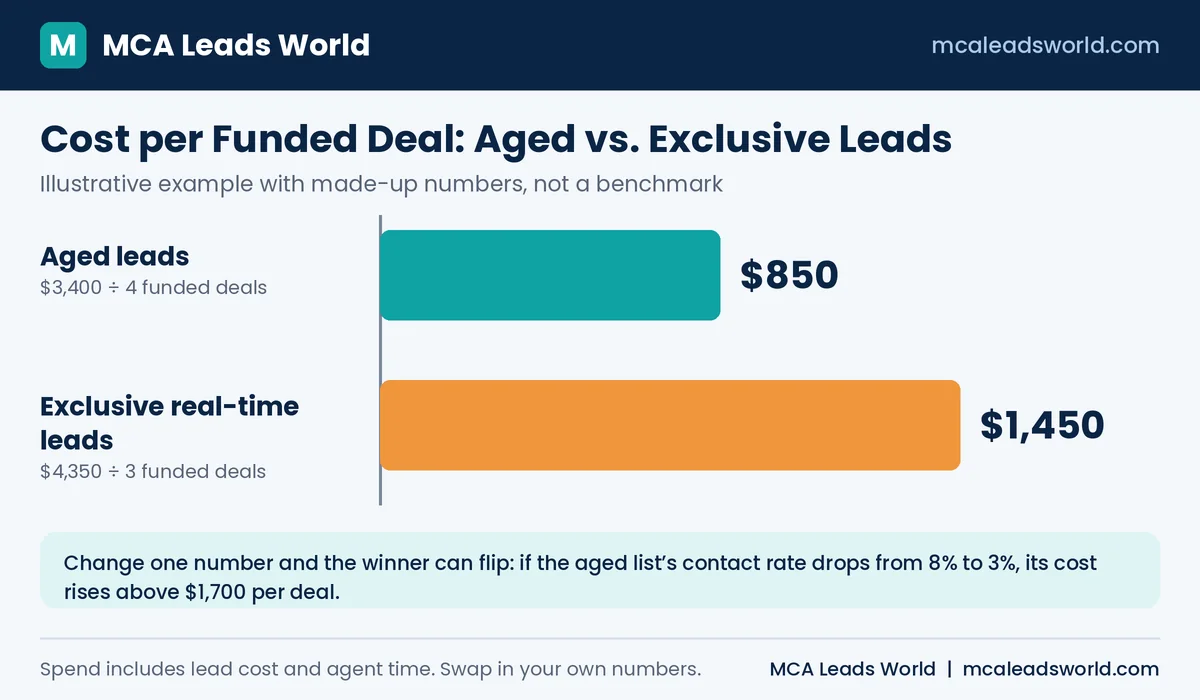
With these numbers, aged leads win. But change one number and the result flips. Say the aged list’s contact rate falls from 8% to 3% because too many buyers got the file. The same spend now gives you fewer than two funded deals, and your cost per deal rises above $1,700. Now say your closers are strong, and the exclusive leads fund at 35% instead of 25%. Scenario B drops to about $1,040 per deal.
Next, add commission. Suppose an average funded deal pays you $3,000. Your real number will depend on deal size and your funder agreement. Scenario A earns $12,000 on $3,400. Scenario B earns $9,000 on $4,350. Both make money. Which one is better depends on what limits you. Aged leads cost less but take more calling time. Exclusive leads cost more, but a small team can do more with them.
That’s why a pitch built around cost per lead tells you very little. The only comparison you can trust is the one you run with your own team, scripts and funders.
What to Track for Every Lead Source
Track these for every lead source: the vendor, the lead’s age, time to first contact, contact status, completed application, approved amount, funded amount, commission and expected renewal date. After 60–90 days, you’ll know more than any vendor can tell you.
How MCA Leads Are Generated (and What You Should Be Able to Audit)
Most MCA leads come from search ads, social ads, direct mail, outbound telemarketing or partner sites. Quality depends on the source, the consent wording and how many buyers get each lead. The path is simple. Traffic arrives. The owner lands on a form or gets a call. They see or hear a consent statement. The lead goes through some kind of check. Then it’s delivered to a buyer.
Quality can drop at every step. For example, a very broad ad brings in curious people instead of owners who need money. Likewise, a form without clear consent wording puts you at legal risk. And a “verified” label might mean someone dialed the number once. It might also mean nothing at all.
What to Ask the Vendor to Show You
- The source. Which channel produced the lead, and can you see the landing page?
- The timestamp. When did the owner submit it, and how fast is it delivered?
- The consent wording. What exact words did the owner see, and do they cover calls and texts from buyers like you?
- The buyer count. How many companies get this lead, and when?
- The replacement policy. What counts as invalid, and how long do you have to claim a credit?
Red flags are easy to spot once you know them: “exclusive” with no number attached, a refusal to show you the form, no timestamps, or pressure to buy a lot before you’ve tested a small batch.
MCA Leads World supplies leads to funders across the USA, and we’re happy to answer these questions in writing. If any provider can’t, including us, that tells you what you need to know.
Free MCA Leads: Where to Find Them
The main free sources of MCA leads are referral partners, past clients and renewals, networking groups, your own content and public UCC filings. Free MCA leads cost time instead of money, and they often convert better than anything you can buy. The catch is that they come in slowly.
- Referral partners. Accountants, bookkeepers, equipment dealers and commercial real estate brokers talk to owners who are short on cash all the time. A bookkeeper who trusts you can send a file that is already organized.
- Past clients and renewals. An owner who paid off an advance with you is your warmest lead. Ask when they might need more money, and ask for introductions.
- Local networking and trade groups. Chambers of commerce and restaurant or contractor groups put you in front of owners while they’re talking about their problems.
- Your own content. A guide like this one brings in owners who raised their hand, with consent built in.
- Public UCC filings. Every state keeps financing statements on record, usually through the Secretary of State. Fees and search tools differ by state, and a filing is still not permission to call or text.
“Free” doesn’t mean free of rules. You still need consent, and do-not-call rules apply to every channel. So most teams use one or two free sources plus a small paid test.
How to Read MCA Leads Reviews
Read MCA leads reviews for patterns across several sites. Then check what you found with references and a small test. A provider with fifty glowing reviews and a pile of unanswered refund complaints is a worse bet than one with fewer reviews and clear fixes.
Look in more than one place: Google, Trustpilot, the Better Business Bureau and broker forums where people complain honestly. Then read for details. A useful review mentions how old the leads were, how many people answered, how replacements were handled or how fast support replied. Generic praise like “great leads, great team” tells you nothing.
Three habits help:
- Search the vendor’s name plus “refund,” “complaint” or “replacement,” and see whether the company replied.
- Be careful with testimonials that appear only on the vendor’s own site, and ask for two or three references you can call.
- Compare review dates. Five five-star reviews posted in the same week deserve a second look.
A review can’t replace your own test. Reviews tell you where to look. The 30-day test later in this guide tells you what you’ll actually get.
Compliance Basics Every Buyer Should Know
Before you contact any MCA lead, make sure you have consent for calls and texts. Then check do-not-call lists, and look up the rules in the state where the merchant works. This section is general guidance, not legal advice. Rules differ by state and change often, so check with a qualified attorney before you build your outreach.
TCPA and Consent
The Telephone Consumer Protection Act (TCPA) limits automated and prerecorded marketing calls and texts to cell phones. You need written consent first. Calls to businesses get more room than calls to consumers. However, small business owners often give a personal or mixed-use cell number on a form, and consent is generally required for those numbers. So a lead with no consent wording attached is a risk, not an asset.
On January 24, 2025, a federal appeals court threw out the FCC’s “one-to-one consent” rule. That rule would have required separate consent for each company. Because of the ruling, one consent form can name more than one company again. But consent is still required. So read what each lead’s consent wording says, and which companies it names, before you rely on it.
Do Not Call Rules
The FTC’s Do Not Call rules focus on calls to consumers, and most business-to-business telemarketing falls outside them. However, the FTC has proposed narrowing that exemption, so don’t build your whole process around it. State lists and company-specific requests can still apply. So keep your own list of people who asked not to be contacted. Check every file against it, and remove any merchant who asks you to stop.
State Laws
Some states have telemarketing laws that are stricter than the federal rules. Florida’s telephone sales law, for example, has led to many lawsuits.
Several states also require written cost disclosures on business financing offers. These include California, New York, Florida, Georgia, Utah, Virginia, Connecticut and Kansas. California’s law has been in effect since December 2022, and it covers merchant cash advances, as the state’s financial regulator announced. These laws mostly apply to the company making the offer. So they matter to both funders and brokers.
Records to Keep
Imagine a merchant or a lawyer challenges one of your calls. The question will be: what can you prove? So save the consent record, timestamp, lead source and do-not-contact history for every lead you reach out to. Also ask your vendor to send these with each lead, not months later when you ask.
Here’s a simple rule. If a vendor says its leads are “TCPA compliant” but won’t show you the consent wording or let you check a sample, treat that phrase as marketing.
Which Type of MCA Lead Fits Your Business?
Solo brokers and small teams usually do best with live transfers or exclusive real-time leads. High-volume floors usually do best with aged and UCC data. The right mix depends on how many people work your leads and how fast they can act.
Solo Broker or New ISO
Your biggest limit is time. So live transfers, or a small number of exclusive real-time leads, keep you talking to people who want funding. Start with a few dozen leads and track everything. Also avoid big volume deals early on. Free sources matter at this stage too. For example, referrals from accountants and equipment dealers cost nothing, and they often convert best.
Small Team (3–10 People)
Give your best closers real-time exclusive leads, and use a smaller amount of aged data for slow times. This is also the stage where a written follow-up process starts to pay off.
High-Volume Sales Floor
Aged leads, UCC data and bulk files make sense if you have good dialer setups, reliable do-not-contact lists and enough people to work a big pool. Here, your edge is your process, not any single lead.
Direct Funder
For you, application-ready files and renewals from your own customers usually matter most. Purchased leads then fill gaps in certain states or industries.
Unsecured Loan and Equipment Finance Providers
The same ideas apply, but the leads look different. Unsecured business loan leads usually come from owners with stronger credit and more years in business. Equipment financing leads should include details about the equipment, like the type, the seller and the rough cost. A lead with a vendor quote in hand is a very different conversation from one with none. Also, don’t assume an MCA lead will work as a loan lead. Qualify each lead for the product you actually sell.
Speed-to-Lead: How to Work MCA Leads
Contact fresh MCA leads as fast as you can while staying professional and compliant. Owners who send one inquiry usually send several, so the first helpful person to reach them has an edge. Some vendors claim that answering within five minutes multiplies your results. Treat that as an idea to test with your own numbers, not a rule. What does hold up is this: a clear next step works better than pressure.
Here’s a workable plan for a fresh lead:
- Call within minutes, from a local-looking number that isn’t flagged as spam.
- If nobody answers, send a short text (only if you have consent). Include your name, your company and one line about why you’re reaching out.
- Try again later the same day. Then try once or twice over the next few days.
- Stop when the owner says no or asks you to stop.
Caller ID matters more than most people think. If your number shows up as “Scam Likely,” few people will answer, and no lead source can fix that. So check your numbers often, and register or rotate them the right way.
Also get your paperwork ready before you dial. A typical file needs a signed application, three to six months of business bank statements, a voided check or bank details, a photo ID, and sometimes a card-processing statement. If your team has to chase the owner for each item one by one, interest fades. The broker who sends a complete file first is the one funders like to work with.
How to Test an MCA Leads Provider in 30 Days
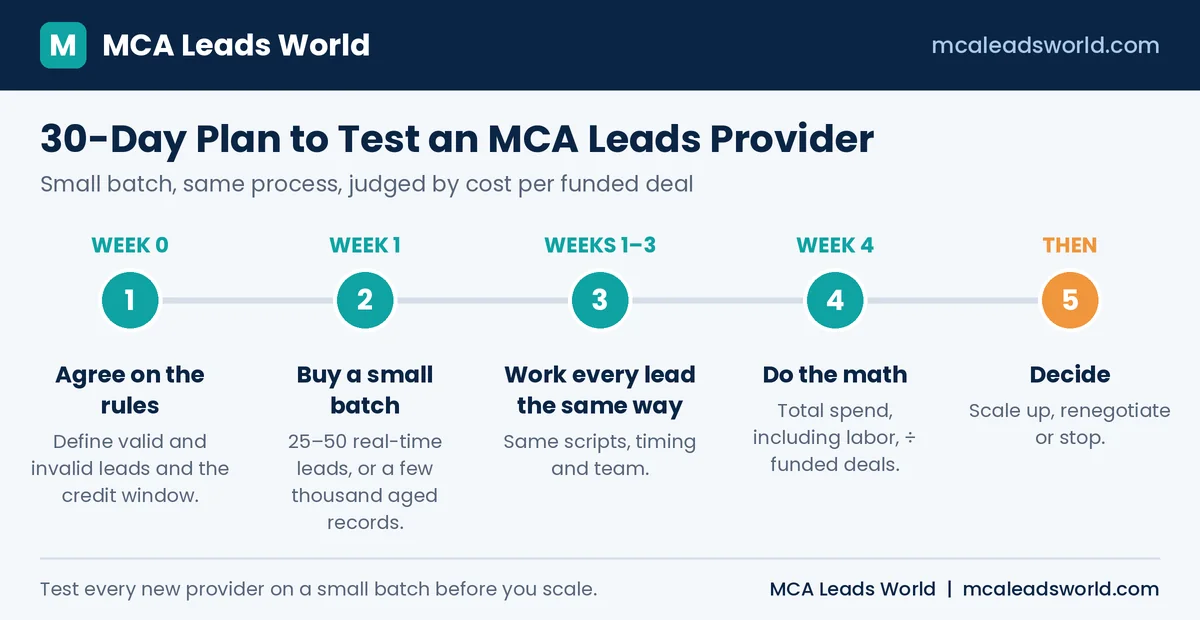
A 30-day test with a small batch, judged by cost per funded deal, is the most reliable way to check any MCA leads provider before you spend big.
The 30-Day Test Plan
- Week 0: agree on the rules. Write down what counts as a valid lead and what counts as invalid (a dead number, a duplicate, the wrong location, not a business). Also write down how long you have to claim a credit and how many buyers get each lead.
- Week 1: buy a small batch. For real-time leads, that might be 25–50. For aged data, a few thousand records. Don’t skip the test just to get a bulk discount.
- Weeks 1–3: work every lead the same way. Use the same scripts, the same timing and the same team. If one agent skips half the list, your results measure the agent, not the vendor.
- Week 4: do the math. Count conversations, applications, offers and funded deals. Then divide your total spend, including labor, by the funded deals. Compare that number to your current best source.
- Decide. Scale up, renegotiate or stop. If results are close, ask for a second batch from a different week to see if the quality holds.
Questions to Ask Before You Purchase MCA Leads
Start with the audit list from the sourcing section above. Then add these:
- Is there a minimum order or a contract length?
- How are leads delivered (API, CRM, email), and how fast?
- What happens to invalid leads, and who decides what counts as invalid?
- Can I speak with a current client?
Green Flags and Red Flags
Green flags: clear answers, a willingness to start small, written replacement terms, and a vendor who tells you which lead type won’t work for your setup. Red flags: vague sourcing, pressure to buy a lot, “guaranteed funded deals” (nobody can promise that), and no sample data.
Want sourcing details before you spend anything? Tell us your lead type, target states and monthly volume, and we’ll send pricing and sourcing information. Request pricing from MCA Leads World.
MCA Leads Glossary
These are the terms used in this guide, in plain language.
- MCA (merchant cash advance): Money a business gets up front and pays back from its future sales, instead of through fixed loan payments.
- ISO or broker: A company or person that finds merchants and sends their deals to funders, usually for a commission.
- Lead: A record of a business owner who has shown interest in funding, or who looks like a good fit for it.
- Exclusive lead: A lead sold to one buyer. The exact meaning changes by vendor, so get it in writing.
- Real-time (fresh) lead: A lead delivered soon after the owner filled out a form or called in. “Fresh” has no standard time limit.
- Aged lead: A lead older than a vendor’s “fresh” window. It’s often resold to several buyers at a lower price.
- Live transfer: A screened call that is connected to your team while the owner is still on the line.
- UCC-1 filing: A public record a lender files to show it has a claim on a business’s assets.
- Stacking: Having more than one advance at the same time. It raises the risk of not repaying, and funders often limit what they’ll offer.
- TCPA: The Telephone Consumer Protection Act, the federal law that limits automated and prerecorded calls and texts without consent.
- DNC (do not call): Federal, state and company lists of numbers you must not call for marketing.
- Cost per funded deal: Your total spend on leads, labor and tools, divided by the number of deals that fund.
MCA Leads FAQ
How much do MCA leads cost?
In 2026, published prices run from a few cents per aged record to about $40–$200 or more per exclusive real-time lead, and $75–$150 or more per live transfer. But price per lead matters less than cost per funded deal. That depends on contact rate, application rate, approval rate and how well your team closes.
Which is better: aged, exclusive or live transfer MCA leads?
None wins for every team. Live transfers and exclusive real-time leads suit small teams with strong closers, because they save prospecting time. Aged leads suit big teams that can work long lists cheaply. The best move is to test a small batch of each and compare cost per funded deal.
Are aged MCA leads worth buying?
They can be, if you call with a clear process, keep consent records, and the vendor hasn’t sold the file to too many buyers. Smaller shops usually do better with referrals and real-time leads first. Then they can add aged data once their process works.
What are UCC leads?
UCC leads come from public UCC-1 filings, which show that a business has taken financing before. They can point to renewal or refinance chances. But a filing doesn’t prove the owner wants money now, and it doesn’t give you consent to contact them.
Is it legal to buy and call MCA leads?
Buying leads is legal. The rules cover how you contact them: consent for calls and texts to cell phones, do-not-call lists, state telemarketing laws and financing disclosure rules. Many owners use mixed-use cell numbers, so keep consent records and talk to a qualified attorney about your process.
How fast should I respond to an MCA lead?
As fast as you can do it professionally and legally. For fresh inquiries, minutes usually beat hours. Still, a clear, helpful first call matters more than the stopwatch. Track your own response times against funded deals to find the right target for your team.
How do I know if an MCA leads provider is legitimate?
Look for clear sourcing, written exclusivity terms, a clear replacement policy, a willingness to run a small test, and references you can call. Also read MCA leads reviews for patterns. Be careful with anyone who promises results or won’t show you where their leads come from.
Where can I find free MCA leads?
The main free sources are referral partners, past clients and renewals, local business groups, your own content and public UCC filings. They cost time instead of money. Consent and do-not-call rules still apply to every channel. Most teams pair one or two free sources with a small paid test.
What is the difference between MCA leads and business loan leads?
MCA leads are owners who want fast money paid back from future sales. Business loan leads are owners who want term loans or credit lines, and they often need stronger credit and more paperwork. Many providers sell both. So qualify each lead for the product you actually offer.
Are exclusive MCA leads really exclusive?
Not always. “Exclusive” has no legal meaning, so it might mean one buyer forever or one buyer for a short time. Ask how many companies get each lead, for how long, and what the contract says if a lead is resold. Get the answer in writing before you buy.
What should an MCA lead replacement policy cover?
A good policy says what counts as an invalid lead, such as a dead number, a duplicate, the wrong state or a non-business. It sets a time limit for claims, explains how credits work and says who settles disputes. Get it in writing. Then test it with a small batch.
How many MCA leads should I buy for a test?
A reasonable start is 25–50 real-time or live-transfer leads, or a few thousand aged records. That’s enough to see contact and application rates without risking much money. Work every lead the same way. Then compare cost per funded deal before you scale up.
Key Takeaways for Buying MCA Leads
Three habits save the most money in this market. First, judge every source by cost per funded deal. Second, find out how a lead was made and who else got it. Third, test small before you scale, because a vendor that works for someone else’s team may not work for yours.
If you want to talk through which lead types fit your team, or see how we handle sourcing, consent and replacements at MCA Leads World, talk to us about your first test and we’ll walk you through it before you spend a dollar.
References and Further Reading
The legal and compliance points in this guide draw on the sources below, current as of October 19, 2026. Rules change, so check for updates before you act.
- Eleventh Circuit Vacates FCC’s TCPA One-to-One Consent Rule on Eve of Effective Date (Pierce Atwood)
- What Are the B2B Telemarketing Consent Requirements? (PossibleNOW)
- The Telemarketing Sales Rule: What Calls Are Covered (Federal Trade Commission, PDF)
- DFPI’s Commercial Financing Disclosure Regulations Approved (California Department of Financial Protection and Innovation)
- UCC filing searches: each state’s Secretary of State website
About the Author
MD Abdul Latif is CEO at MCA Leads World, with 14 years of experience in merchant cash advance and small business funding. Connect on LinkedIn.