MCA Applications with Bank Statements: Funder Guide
MCA applications with bank statements are the starting point for almost every merchant cash advance decision. The application tells you who the business is. The statements show how money really moves. Together, they let you judge risk in minutes instead of days.
But a package only helps if it is complete, current, and honest. One missing page can stall a deal. One doctored statement can cost you an advance you never get back. This guide shows what a strong package contains, how underwriters read it, and which red flags to catch early.
It is written for funders, ISOs, and brokers who work with small business owners across the USA. That includes merchant cash advance providers, unsecured funding companies, and equipment and small business capital firms. You will find a worked example, a sample template, and a checklist you can use today.
Quick answer: An MCA application with bank statements is a merchant cash advance request packaged with 3 to 4 months of recent business bank statements. Funders use the statements to confirm real revenue, average balances, bounced payments (NSFs), and existing advances before they set an offer.
Key takeaways
- A complete package has a signed application, 3 to 4 consecutive months of statements for every operating account, an ID, and a voided check.
- Remove non-revenue deposits before you judge a merchant’s sales.
- Holdback = daily debits x business days / true monthly revenue.
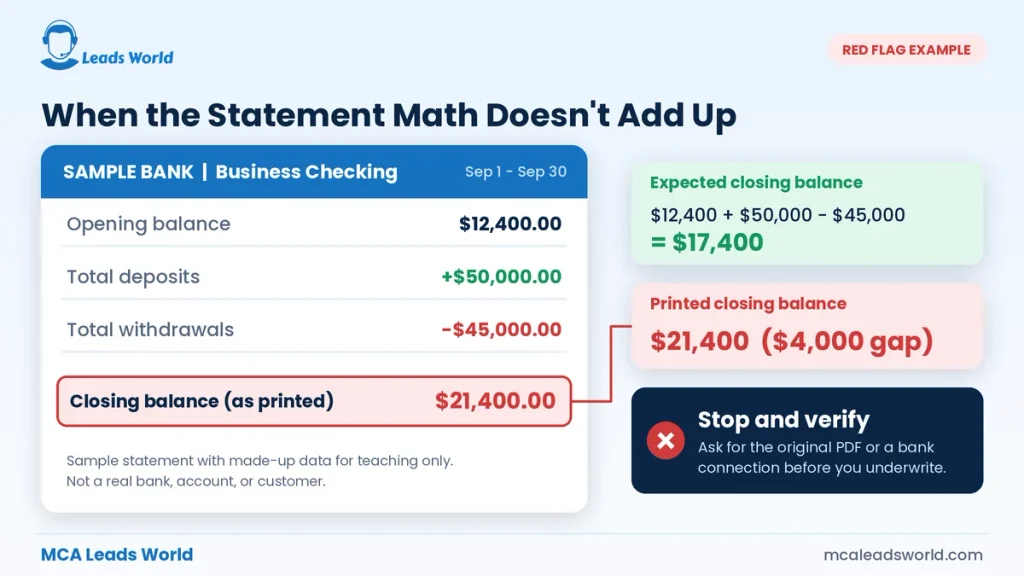
- Check the statement math first. Opening balance + deposits – withdrawals must equal the closing balance.
- Keep statements fresh (about 30 days old at most) and follow your state’s disclosure rules.
By MD Abdul Latif · Last updated: November 19, 2026 · Based on the sources listed at the end.
What Are MCA Applications With Bank Statements?
The simple definition
An MCA application with bank statements is a funding request packaged with recent business bank statements. The application covers the owner and the business. The statements cover cash flow. Underwriters need both to make a decision.
Why funders rely on statements
A merchant cash advance is repaid from future sales. So underwriters care less about a credit score and more about deposits, balances, and existing debits. Bank statements show all three. They also show what a business owner leaves off the form.
Three common package types
| Package type | What is inside | Underwriting readiness | Typical gap |
|---|---|---|---|
| Application only | Form and owner details | Low | No proof of cash flow |
| Application with statements | Form plus 3 to 4 months of statements | High | Missing supporting documents |
| Full file | Form, statements, ID, voided check, processing statements, signed authorization | Highest | Stale documents |
What a Complete Merchant Cash Advance Application Includes
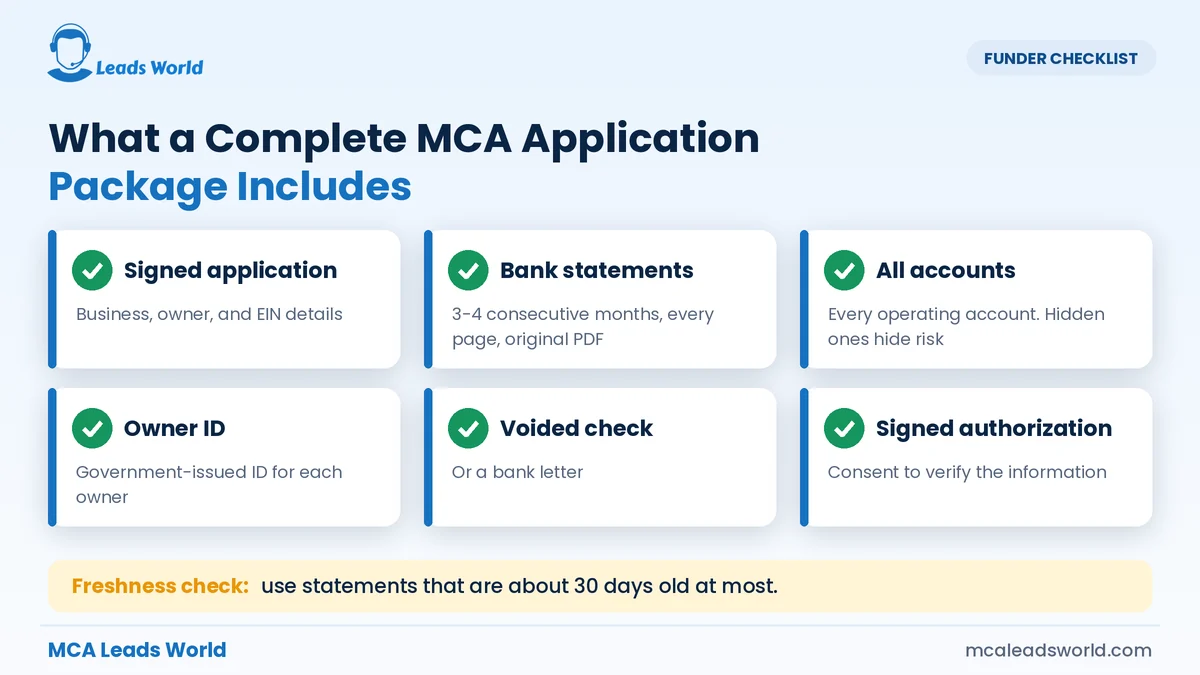
A complete merchant cash advance application does more than collect a name and a number. It gives the underwriter everything needed to say yes, no, or “not at this size” on the first pass.
The MCA loan application form: key fields
A solid MCA loan application form asks for:
- Legal business name and DBA
- EIN, entity type, and business address
- Owner names, ownership percentages, and identity details
- Time in business and industry
- Estimated monthly revenue and amount requested
- Any current advances or loans
- Owner signature and date
Bank statement requirements for MCA
The bank statement requirements for MCA are simple, but they are strict:
- Consecutive months. No gaps.
- Every page. Even the pages that look empty.
- Every operating account. A hidden account hides risk.
- Original PDFs. Download them from the bank. Screenshots and photos are weak evidence.
- Matching names. The account holder should match the business on the application.
3 months bank statements MCA vs. 6 months business bank statements
Three months of statements is the most common ask. Greenbox Capital, for example, lists three months on its page. Some funders want four to six months, especially for larger advances.
Six months of business bank statements help with seasonal companies. Picture a pool-service business. December looks weak and June looks strong. Three winter months would make it look risky. Six months show the real swing.
Small business cash advance documents beyond statements
Statements are the core, but they are not the whole file. Most funders also ask for:
- A government-issued ID for each owner
- A voided check or bank letter
- Proof of ownership or entity status
- Card processing statements, if the merchant takes cards
- A signed authorization to verify information
Keep the package fresh
Statements older than about 30 days miss the newest activity. A merchant could have taken a new advance since then. Ask for the latest month before you commit.
Merchant Cash Advance Application With Bank Statements: Template, PDF and Online Options
Many funders search for a merchant cash advance application with bank statements template or PDF. Here is what a good one needs, and how the formats compare.
A simple template layout
Use four blocks. Keep the labels plain.
- Business: legal name, DBA, EIN, address, industry, start date
- Owners: names, ownership percentage, contact details, ID upload
- Financials: monthly revenue, requested amount, current advances, bank name
- Authorization: consent to review statements, signature, date
This is a sample layout, not legal text. Have counsel review the authorization language before you use it.
PDF application
A merchant cash advance application with bank statements PDF is easy to email and print. However, someone has to re-type it into your system. That causes typos, and typos cause delays.
Online application
An online form checks required fields as the owner types. It also captures an e-signature and a timestamp. In short, it saves time and leaves an audit trail. The trade-off is that you need a secure portal.
Merchant Cash Advance Underwriting: A Six-Step Bank Statement Analysis for MCA
Good underwriting follows the same order every time. That way, you never skip a check when the pipeline gets busy. Here is a six-step bank statement analysis for MCA.
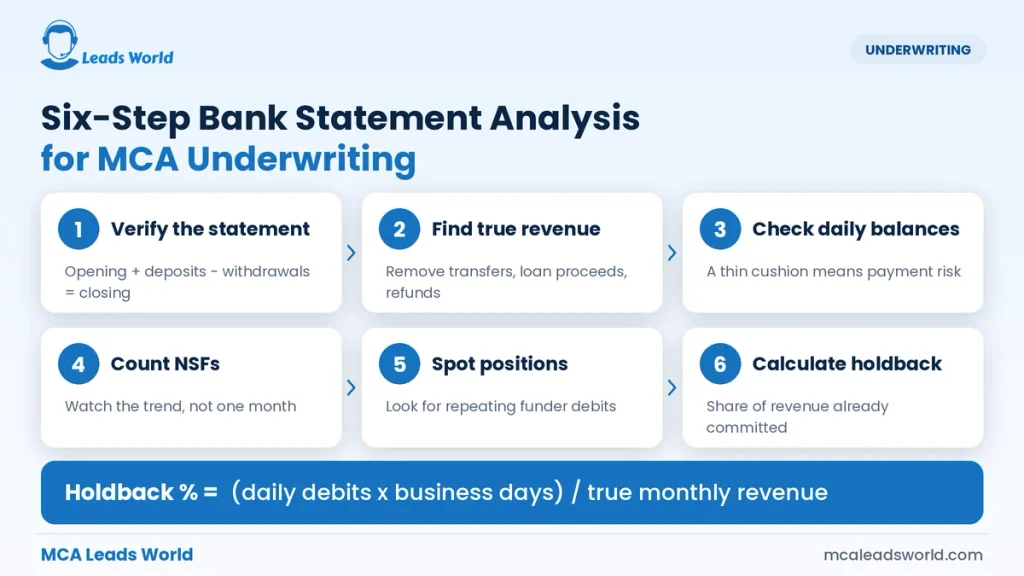
Step 1: Verify the statement itself
Start with the math. Opening balance, plus deposits, minus withdrawals should equal the closing balance.
Here is a quick example. A statement opens at $12,400. It shows $50,000 in deposits and $45,000 in withdrawals. The closing balance should be $17,400. If it says $21,400, stop. Something was edited.
Step 2: Separate true revenue from other deposits
Not every deposit is a sale. Remove these before you judge the business:
- Transfers between the owner’s accounts
- Loan or advance proceeds from other funders
- Vendor and customer refunds
- Personal payments from friends or family
- One-time owner cash injections
What is left is true revenue.
Step 3: Review average daily and ending balances
Low balances mean a daily or weekly debit may bounce. A business can show $45,000 in deposits and still sit near zero most days. That tells you the money leaves as fast as it arrives.
Step 4: Count NSFs and negative days
NSF means “non-sufficient funds.” It is a bounced payment. One NSF in a year is not alarming. A rising count over three months is. Look at the trend, not just the total.
Step 5: Spot existing positions and stacking
Look for fixed, repeating debits to other funders. Each active advance is a “position.” Stacking means taking new advances while old ones are still active. Heron Data’s glossary explains why this raises default risk.
Step 6: Estimate holdback and capacity
Holdback is the share of revenue that already goes to funders. Use this formula:
Holdback % = (combined daily debits x business days) / true monthly revenue
One ISO, CFG Merchant Solutions, notes that funders get cautious once repayments pass roughly 20% to 25% of collections. Treat that as a guide, not a law.
Worked example: a plumbing company (illustrative numbers)
These numbers are made up, but the pattern is common.
| Month 1 | Month 2 | Month 3 | |
|---|---|---|---|
| Gross deposits | $48,500 | $51,200 | $44,800 |
| Owner transfers | -$3,000 | -$2,200 | $0 |
| Other funder proceeds | $0 | -$10,000 | $0 |
| Vendor refunds | $0 | $0 | -$1,300 |
| True revenue | $45,500 | $39,000 | $43,500 |
| Average daily balance | $6,800 | $4,900 | $2,600 |
| NSFs | 0 | 2 | 4 |
- Average gross deposits: about $48,167. Average true revenue: about $42,667. Reading gross deposits would overstate sales by roughly 13%.
- The company pays two funders: $350 and $225 per day. That is $575 a day, or about $12,075 over 21 business days.
- Holdback: $12,075 / $42,667 = about 28.3%.
Verdict: the holdback is already above the comfort zone. Balances are falling and NSFs are rising. There is no room for a new advance. A careful funder might decline, or offer a smaller deal only after one position is paid off.
Read the trend, not one month
Month 1 of that file looks fine on its own. Months 2 and 3 tell the real story. Always line up the months side by side.
Typical Requirements Funders Look For
Requirements change from funder to funder. These are published ranges, not rules.
| Requirement | Range seen across funders |
|---|---|
| Monthly revenue | About $7,500 to $15,000 or more (Greenbox lists $7,500. Credibly, as shown by Nav, lists $15,000) |
| Time in business | A few months up to six months or more |
| Bank statements | 3 months is common. 4 to 6 months for bigger or seasonal deals |
| Offer size | Roughly 70% to 150% of monthly revenue, depending on the source |
| Factor rate | About 1.1 to 1.5, per NerdWallet and Greenbox |
Why the numbers differ
Four things move the bar: the funder’s risk appetite, the tier of merchant they serve, the industry, and the repayment method. A prime-tier funder asks for more. A high-risk funder prices the risk instead.
Red Flags in MCA Applications With Bank Statements
Fraud checks belong at intake, not after funding. Onyx IQ’s fraud overview is a good primer. These are the signs to watch for in MCA applications with bank statements.
Signs of altered statements
- Math that does not reconcile, like the $17,400 vs. $21,400 example above
- Fonts, spacing, or logos that shift between pages
- A statement that looks too clean or generic
- Running balances that jump without a matching transaction
Bank statement scrubbing is the term for removing unfavorable lines before submission. Spot-check anything that looks edited.
Identity and entity mismatches
Check that the business name, EIN, address, and account holder all agree. A name that differs even slightly deserves a call.
Financial warning signs
- Round-number deposits right before the application date
- Hidden or missing accounts
- Personal and business spending mixed together
- A sudden jump in deposits with no clear source
Duplicate or recycled packages
The same package can reach more than one buyer. Ask any source whether files are unique, how old they are, and how many buyers receive them.
MCA Applications With Bank Statements Online: PDF Upload vs. Bank Connection
Online intake usually works in one of two ways. Each has strengths.
| PDF upload | Live bank connection | |
|---|---|---|
| Speed | Slower, needs review | Faster, data arrives structured |
| Tamper risk | Higher | Lower |
| Merchant comfort | Familiar | Some owners worry about sharing a login |
| Best for | Backup and manual review | First-pass screening |
Many funders use both. They connect the bank for speed and keep the PDF for records.
How owners submit bank statements for merchant cash advance approval
Owners usually submit bank statements for merchant cash advance review in one of three ways: a secure upload link, an email to the ISO, or a connected bank account. Give them one clear path. Confusing instructions create missing pages.
MCA broker submission tips for ISOs
The ISO merchant cash advance channel lives on clean files. Heron Data describes an ISO submission as a package of application, statements, and supporting documents. A strong MCA broker submission also includes:
- One-page deal summary with the ask and the industry
- A list of known positions and daily payments
- Short notes explaining large or unusual deposits
- Native PDFs, named by month
- Signed consent to verify
Clear files get faster answers from funders.
Bank Statement Patterns by Industry
Deposit rhythms differ by trade. Read them in context.
- Restaurants and retail: Many small card deposits each day. Watch processor settlements.
- Trucking: Larger, less frequent deposits. Fuel and repair debits are heavy.
- Construction and contractors: Lumpy deposits tied to project milestones.
- Medical and professional practices: Steady deposits, but insurer delays can create gaps.
Why Applications Stall or Get Declined at the Statement Stage
Most delays come from a short list of problems:
- Missing pages. Ask for the full PDF again.
- Unreadable scans. Request originals from the bank.
- An account left out. Ask whether other accounts exist.
- Name mismatches. Confirm the legal name and DBA.
- Heavy NSFs. Request an explanation and a recent balance.
- Stacking above your limit. Offer a smaller deal or pass.
- Large unexplained deposits. Ask for a short written note.
Fixing these early shortens the path from submission to decision.
Business Loan With No Bank Statements: Is It Real?
Owners often ask for loans that don’t check bank statements. Honestly, it is rare. Most alternative funders rely on statements because they show cash flow.
Some products lean on other data instead:
- SBA-style loans: tax returns and financial statements
- Equipment financing: the equipment itself is collateral
- Invoice factoring: your customers’ credit and invoices
- Business credit cards: personal and business credit history
Also, connecting a bank account online is not the same as skipping bank statements. The funder still sees your cash flow.
Be careful with any offer that promises approval with no documents at all. Real funders verify. Upfront fees for a “guaranteed” approval are a classic warning sign.
MCA Bank Statement Terms, Explained
These eight terms come up on almost every underwriting call.
| Term | Plain-English meaning | Why it matters |
|---|---|---|
| True revenue | Deposits from real sales, after removing transfers, loan proceeds, and refunds | It is the base for every ratio |
| Average daily balance (ADB) | The average amount sitting in the account each day | It shows the cushion for daily or weekly debits |
| NSF | A payment that bounced because of insufficient funds | It signals cash-flow stress |
| Position | One active advance | The count shows how crowded the file is |
| Stacking | Taking new advances while older ones are still active | It raises default risk |
| Holdback | The share of revenue already going to funders | It limits room for a new advance |
| Factor rate | The multiplier that sets the payback amount (for example, $20,000 at 1.3 repays $26,000) | It sets the total cost |
| ISO | An independent sales organization that sends deals to funders | It is the source of many submissions |
Compliance: What Funders Should Check in 2026
Rules change often. Treat this section as a starting point and confirm details with counsel.
State disclosure laws
Roughly ten to eleven states now require commercial financing disclosures. They include California, New York, Florida, Georgia, Virginia, and Utah. JD Supra’s overview lists the requirements and exemptions.
MCA applications with bank statements in California
California’s commercial financing rules generally cover offers of $500,000 or less. They call for key terms such as total funded amount, total cost, and estimated APR. For California files, also confirm the business name against the Secretary of State record. DBAs are often filed at the county level, so check both.
Texas registration
Recent summaries say providers and brokers doing business in Texas must register starting December 31, 2026. Confirm timing and scope with the state regulator.
Handling statements safely
Bank statements contain sensitive data. Use encrypted transfer, limit who can open files, and set a retention schedule. Always keep a record of the owner’s consent.
How to Source Reliable Application Packages
Quality varies a lot between sources. Before you commit to one, ask these questions:
- How recent are the statements?
- Are packages exclusive, or shared with other buyers?
- What counts as “complete” in your standard?
- How do you verify statements before delivery?
- Do you keep proof of applicant consent?
- What is the replacement policy for bad files?
- In what format and how fast do files arrive?
- Can you share sample files with sensitive data removed?
If you are comparing sources, start with our guide to MCA leads. Older files can still work for follow-up. Read more about aged MCA leads before you decide. You can also see how an MCA leads provider like ours supports funders across the USA.
Frequently Asked Questions About MCA Applications With Bank Statements
How many months of bank statements do MCA funders want?
Most ask for three months. Some want four to six, especially for larger or seasonal deals. Ask each funder for its rule before you submit.
Can I get an MCA with only 3 months of statements?
Yes, many funders approve with three months. The statements need to show steady deposits, healthy balances, and few NSFs. A newer business may qualify for a smaller amount.
What is the difference between an application with statements and a raw lead?
A raw lead is contact information and basic details. An application with statements includes cash-flow proof. That makes it faster to underwrite.
Do MCA deposits count as revenue?
No. Proceeds from another advance are financing, not sales. Underwriters remove them when they calculate true revenue.
How do funders spot altered statements?
They check that balances reconcile, compare fonts and layouts, and look for odd jumps. Many also cross-check with a live bank connection.
Do funders prefer PDF statements or a bank connection?
Many prefer a bank connection for speed and lower tamper risk. They often keep the PDF for records. The best choice depends on the funder’s process.
What other documents do funders need besides statements?
Expect a signed application, ID, and a voided check. Some also ask for processing statements and proof of ownership.
How fresh should a package be?
About 30 days old at most. Older files may miss new advances or recent problems.
What do underwriters check first on a bank statement?
Authenticity comes first. They confirm the balances add up and the layout looks original. Next they calculate true revenue, then review average daily balances, NSFs, and existing funder payments. Together, those checks show whether the business can handle another daily or weekly payment.
What is a good holdback percentage for an MCA?
There is no single rule. CFG Merchant Solutions notes that funders grow cautious once total repayments pass roughly 20% to 25% of collections. Lower is safer. Each funder sets its own limit, so check its guidelines before you submit a file.
Is a merchant cash advance a loan?
Usually not by structure. An MCA is typically written as a purchase of future sales, not a loan. However, several states now require loan-style disclosures for commercial financing, including MCAs. Funders should confirm how their state treats the product.
Do MCA funders ask for tax returns?
Often no, especially on smaller advances. Bank statements carry most of the weight. Larger deals or higher-risk files may trigger requests for tax returns, a profit and loss statement, or a lease. Ask each funder for its document list.
Can a merchant with bad credit get approved based on bank statements?
Sometimes. MCA underwriting leans on cash flow, so strong deposits and balances can offset a weak credit score. However, heavy NSFs or stacking can still lead to a decline. Each funder weighs credit differently.
How long does MCA underwriting take?
Timing varies. Many funders advertise decisions within about one business day once the file is complete. Missing pages, unclear deposits, and name mismatches add days. A complete package is the fastest route to an offer.
Is it safe to email bank statements to a funder?
Email is the weakest option. Bank statements hold account numbers and transaction detail. Use an encrypted upload portal or a secure bank connection instead. Limit who can open the files, and set a retention schedule.
What is an ISO in merchant cash advance?
ISO stands for independent sales organization. An ISO sends merchant files to funders and often earns a commission. A good ISO submits a clean package: application, statements, ID, and notes on unusual deposits.
Do California MCA applications work differently?
The package is the same, but California’s commercial financing rules apply. They generally cover offers of $500,000 or less and call for key disclosures. Also match the business name to the Secretary of State record before you submit.
Conclusion: Build a Repeatable Review Process
Strong MCA applications with bank statements save time because they answer the big questions up front. Check completeness, verify the math, strip out non-revenue deposits, calculate holdback, and watch the trend. Then follow the compliance rules for your state.
If you need help sourcing reliable packages, talk to our team. You can also read more MCA funding guides on our blog.
This article is for education only. It is not legal or financial advice. Consult a qualified attorney about your compliance obligations.
Sources and Further Reading
We reviewed the pages below in November 2026. Figures and rules change, so check each funder’s current guidelines before you rely on them.
- Greenbox Capital: Merchant cash advances
- NerdWallet: What is a merchant cash advance?
- Nav: Merchant cash advance guide
- CFG Merchant Solutions: Minimum criteria to qualify for an MCA
- Heron Data: Cash advance stacking
- Heron Data: Bank statement scrubbing
- Heron Data: ISO submission
- Onyx IQ: Fraud prevention and MCA, an overview for funders
- JD Supra: Commercial financing disclosure requirements and exemptions
About This Guide and MCA Leads World
MD Abdul Latif wrote this guide for funders, ISOs, and brokers. MD Abdul Latif is CEO at MCA Leads World, with 14 years of experience in merchant cash advance and small business funding. Connect on LinkedIn. Article compares published funder criteria, industry glossaries, and legal summaries. The worked example uses invented numbers to teach the method.
MCA Leads World is an MCA lead provider serving funders across the USA. That gives us a commercial interest in this topic, so we kept the advice neutral and listed our sources. Laws change often. Confirm compliance details with a qualified attorney.