MCA Live Transfer: Costs, Criteria & Compliance Guide (2027)
MCA live transfer calls put you on the phone with a business owner who wants funding right now. A call agent finds the owner, checks a few basics and connects the live call to your rep. As a result, you skip the cold dialing and the dead ends.
Still, many funders feel lost when they shop for MCA live transfers. Vendors quote anywhere from about $30 to $200 or more per call, and almost nobody explains why. Worse, a cheap call that never funds can cost you more than an expensive one that does.
This guide clears that up. You’ll see how an MCA live transfer works, what vendors really promise and what you should pay. You’ll also get a simple ROI formula, a contract checklist, a compliance overview and a pilot plan. We wrote it for merchant cash advance providers, small business funding companies, unsecured loan providers and equipment finance shops.
How we put this guide together: we read the public criteria and pricing pages of several MCA live transfer vendors in November 2026. We also checked law-firm analyses for the compliance section. Every price in this guide comes from a vendor page or a third-party report, and we say which. We don’t invent case studies.
By MD Abdul Latif | Last updated: November 24, 2026
Key takeaways
- An MCA live transfer is a phone call where an agent screens a business owner and then connects the live call to your rep.
- Vendors list prices from about $30 to $200 or more per transfer, but price alone tells you little.
- Judge every vendor by cost per funded deal, not cost per call.
- Get the buffer time, the bad-transfer policy and recording access in writing.
- TCPA rules, Do Not Call lists and state financing laws all apply, so check with a lawyer.
- Test any vendor with a 30-transfer pilot before you spend big.
What Is an MCA Live Transfer?
An MCA live transfer is a phone call where an agent talks to a business owner who wants funding, checks a few basics, and then connects the live call to your funding rep. With merchant cash advance live transfers, you speak with a screened owner in real time. You don’t chase a list or wait for a form.
Here’s a quick refresher. A merchant cash advance (MCA) gives a business cash upfront. The business pays it back from future sales, usually with a fixed fee called a factor rate. For more background on the product, NerdWallet’s merchant cash advance guide is a good place to start.
Now picture the old way. A rep dials hundreds of numbers and has only a handful of real conversations. Most owners on the other end don’t want funding at all. With MCA live transfer leads, that dialing happens somewhere else. Your rep picks up only when a screened owner is already on the line.
How an MCA Live Transfer Works, Step by Step
Every vendor runs things a little differently. Still, most follow the same six steps:
- Outreach. The vendor’s agents contact business owners by phone, web forms, ads or other channels.
- Pre-screening. The agent asks about time in business, monthly revenue and how much money the owner wants.
- Consent. The owner agrees to speak with a funding specialist.
- The warm bridge. The agent connects the call to your rep. Many vendors play a short “whisper” message first, so your rep hears the basics before the owner does.
- The handoff. The agent drops off, and your rep takes over.
- The application. Your rep gathers documents and submits the deal.
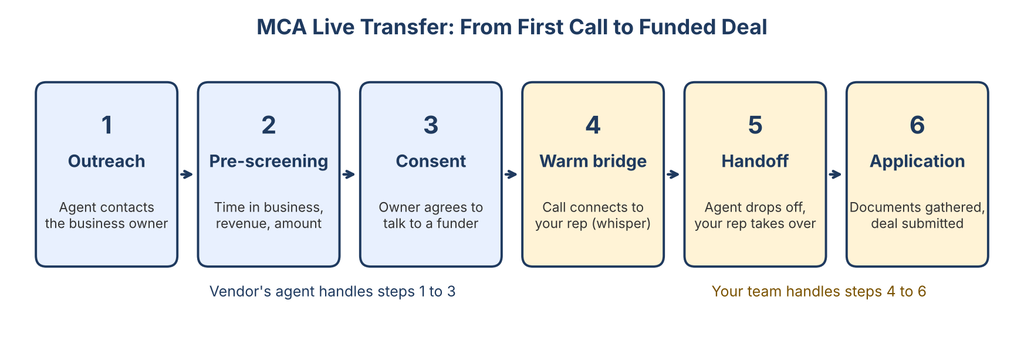
An MCA live transfer from first call to funded deal. The vendor handles steps 1 to 3, and your team handles steps 4 to 6.
The call usually lands on a dedicated phone line that your team answers. Speed matters here. If nobody picks up fast, the owner hangs up, and you might still pay for the call.
MCA Live Transfer vs. Press-1, Hot Transfers and Appointments
People mix up these terms all the time, so here’s a quick guide:
| Term | What it means | Who talks first |
| MCA live transfer | A screened owner is connected live to your rep | A human agent |
| Press-1 call | A recording asks the owner to press 1 to speak with someone | A recording |
| Hot or warm transfer | Often the same as a live transfer, but vendors use the words loosely | Varies |
| Appointment setting | The vendor books a time for a later call | A human agent |
| Real-time web lead | An owner fills out a form, and you call them back | Nobody yet |
Press-1 calls deserve extra caution. The owner never spoke with a person, so intent is often lower. If a vendor calls a press-1 flow a “live transfer,” ask for details. To see how fresh web leads work, read our MCA leads guide.
Who Uses MCA Live Transfers?
Funders of every size use MCA live transfers. Their needs differ, though.
MCA and Cash Advance Providers
Speed is everything here. Owners often need cash within days, so a live call beats a form that sits in a queue. Merchant cash advance live transfer leads also let you explain factor rates while the owner is still interested.
Small Business Funding Companies
Many funders offer more than one product. A good vendor lets you route transfers by product. For example, one owner gets a cash advance offer, and another gets a term loan.
Unsecured Loan and Unsecured Funding Companies
Your credit and revenue rules are stricter, so screening matters even more. Ask the vendor how they check credit before the transfer. Then compare their answer with your own minimums.
Equipment Finance and Small Business Capital Providers
You need owners who want equipment or a set amount of capital. Add “use of funds” and “funding amount” to your filters. That way, you don’t spend rep time on owners who want something else.
ISOs, Brokers and Direct Funders
Brokers who shop deals to many funders need different volume than a direct funder. Some vendors also set eligibility rules. For example, Lead Tycoons lists a minimum number of reps for brokerage accounts. Check the rules before you sign.
MCA Live Transfer Criteria: What Vendors Promise
Every vendor says its transfers are “qualified.” But qualified for what? The answer changes by vendor. Here’s what some vendors publish on their own sites:
| Vendor | Time in business | Monthly revenue | FICO | Funding timeline |
| mcaleads.online | 1 year or more | $15K or more | 550 or higher | 30 days |
| MCA Leadz | 6 months or more | $15K or more | Not listed | ASAP to 2 weeks |
| Lead Tycoons | 6 months or more | $10K or more | Not listed | 30 days |
| Synergy Direct Solution* | 6 months or more | $15K or more | 500 or higher | Not listed |
*Synergy’s numbers come from the VA Horizon comparison, not from Synergy itself. We checked these pages in November 2026. Vendors change their rules, so confirm before you buy.
Some vendors add filters that most guides skip. For instance, MCA Leadz screens for open positions and for too many negative days or NSFs. (An NSF means a bank account ran short when a payment came due.) The mcaleads.online page also excludes certain industries, such as trucking, bail bonds and collections.
Filters That Change Transfer Quality
These are the filters worth asking about:
- Industry. Some industries are riskier for your underwriting.
- State. Certain states add extra rules for funders.
- Funding amount. A $5,000 request and a $150,000 request need different reps.
- Open positions. An owner with three active advances is a harder deal.
- Bank health. Ask about NSFs and negative days.
- Decision-maker check. Make sure the person on the phone can sign.
Build Your Own Underwriting Box
Don’t just accept a vendor’s definition of “qualified.” Write your own buy box first. List your minimum time in business, minimum monthly revenue, credit floor, banned industries and banned states. Then send it to the vendor in writing. A good vendor will tell you whether they can match it.
How Much Does an MCA Live Transfer Cost?
You’ll find MCA live transfers for sale on vendor websites, in forums and even on freelance marketplaces such as Fiverr. Many vendors sell MCA live transfer leads in packages, such as 200 or 300 calls. Prices vary a lot, and so does quality. Here are the published numbers we found:
| Source | Listed price | Note |
| Lead Tycoons | $6,000 for 200 calls, $9,000 for 300 (about $30 each) | Vendor-listed |
| MCA Leadz | $35 per transfer | Vendor-listed |
| MCA Leads Pro | $80 to $200 or more | Reported by VA Horizon |
| The Leads Warehouse | $75 to $150 or more | Reported by VA Horizon |
Treat the third-party numbers as hints, not quotes. VA Horizon is a comparison site, and prices change often.
What Drives the Price
So why does one transfer cost $30 and another $150? Several things push the price up:
- Tighter filters. Higher revenue, better credit and longer time in business all cost more.
- Exclusivity. A transfer sold to one funder costs more than a shared one.
- Geography and industry. Some states and trades are in higher demand.
- Volume. Bigger monthly orders often earn lower per-call prices.
- Buffer time. A longer buffer protects you, and some vendors charge for that protection.
- Agent quality. A trained, US-based agent costs more than someone reading a script.
Cost per Transfer vs. Cost per Funded Deal
Here’s the catch. A cheap transfer that never funds is the most expensive transfer you can buy. The only number that really matters is what you pay for each funded deal. The next section shows how to work it out.
MCA Live Transfer ROI: Cost per Funded Deal
You don’t need fancy software. Just follow the chain:
Transfers × connect rate × application rate × approval rate × funding rate = funded deals
Then divide your spend by your funded deals:
Total spend ÷ funded deals = cost per funded deal
A Worked Example
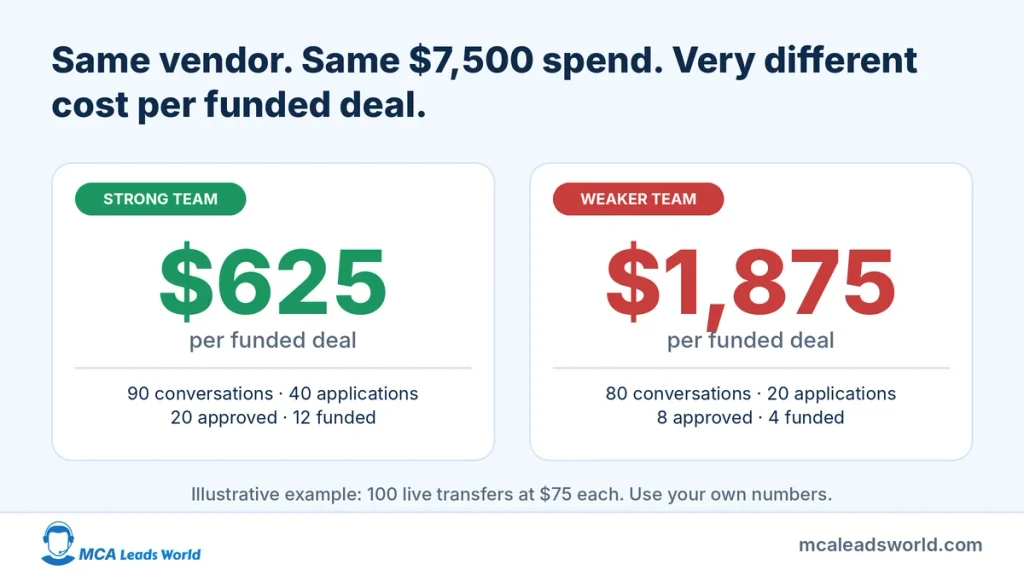
These numbers are made up to show the math. Use your own data instead. Both teams buy 100 MCA live transfers at $75 each, so each spends $7,500.
| Scenario A: strong team | Scenario B: weaker team | |
| Real conversations | 90 | 80 |
| Applications sent | 40 | 20 |
| Approved | 20 | 8 |
| Funded | 12 | 4 |
| Cost per funded deal | $625 | $1,875 |
| Revenue at $2,500 per funded deal | $30,000 | $10,000 |
| Left after the $7,500 lead cost | $22,500 | $2,500 |
Same vendor, same price, three times the cost per funded deal. The difference came from closer skill and call handling, not from the transfers themselves.
Break-Even Check
Staff, software and overhead come out of those leftover numbers too. So Scenario B may barely break even. The lesson is simple: fix your close process first, then scale your spend.
Billing Terms to Lock In Before You Buy
Strong vendors put these terms in writing. Weak ones stay vague. Ask about all five.
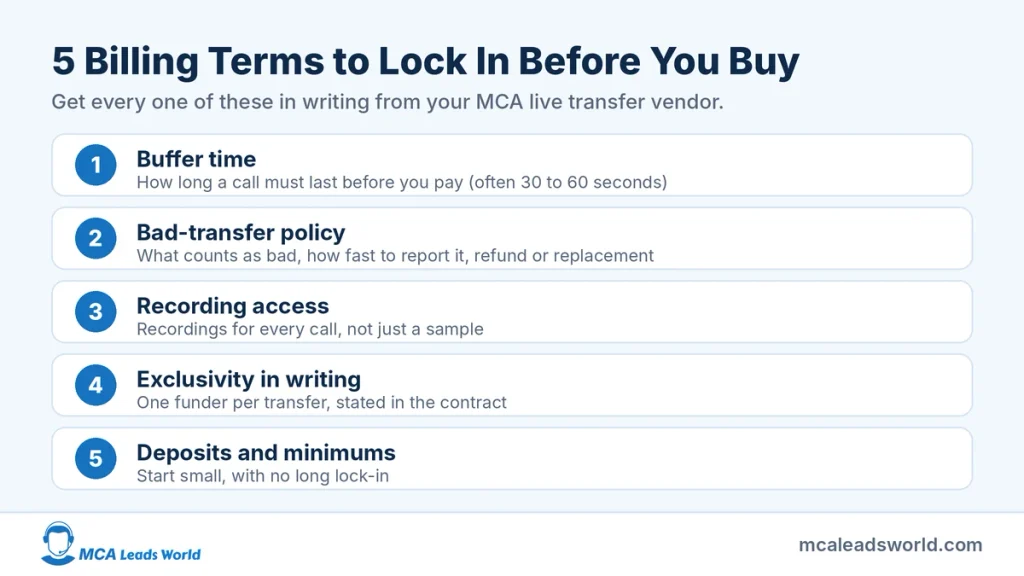
Buffer Time
Buffer time is how long a call must last before the vendor bills you. Meridian Leads describes a window of 30 to 60 seconds. If a call drops after 10 seconds, you shouldn’t pay.
Bad-Transfer Policy
Ask what counts as a bad transfer. For example, MCA Leadz says it won’t charge for transfers that miss the criteria you agreed on. Then ask how fast you must report a bad call and whether you get a refund or a replacement.
Recording Access
You need call recordings. Without them, you can’t dispute a transfer or prove consent. Ask for access to every call, not just a sample.
Exclusivity in Writing
“Exclusive” should mean one funder per transfer, so ask the vendor to state that in the contract. Then test it. If owners tell you three other funders already called, something is off.
Deposits and Minimums
Also check for upfront deposits, monthly minimums and contract length. A fair vendor lets you start small.
Are MCA Live Transfers Right for Your Team?
They’re a great fit for some teams and a waste for others.
When They Pay Off
- Your closers have real experience.
- You can answer within 10 to 15 seconds.
- You run a dedicated phone line.
- Your budget covers a proper test.
When to Start With Something Else
Hold off if your team is brand new or can’t answer calls fast. A missed transfer is money gone. In that case, cheaper lists such as aged MCA leads let your reps practice at lower cost.
Live Transfers vs. Other Lead Types
| Option | Speed | Cost per contact | Best for |
| MCA live transfers | Instant | Higher | Skilled closers who answer fast |
| Web leads | Minutes to hours | Medium | Teams with strong follow-up |
| Appointments | Scheduled | Medium to high | Teams that prefer planned calls |
| Older data lists | Slow | Low | New reps and tight budgets |
In practice, many funders mix two or three of these.
How to Handle an MCA Live Transfer Call: The First 90 Seconds
You paid for this call, so the first 90 seconds decide whether it was worth it.
Answer Rules
- Pick up within 10 to 15 seconds.
- Use a dedicated line, so reps know a transfer is coming.
- Set daily caps so closers don’t get overloaded.
- Train reps to listen to the whisper message.
Don’t Re-Qualify
The vendor already asked the basic questions. If you ask them again, the owner gets annoyed. Instead, confirm what you heard and build trust.
Example: “Hi Maria, this is Dan. I hear you run a bakery and need around $40,000 for new ovens. Did I get that right?”
Move Toward Submission
Next, ask for documents. Most funders need recent bank statements to review a deal. You can learn how to ask for them in our guide on MCA applications with bank statements.
Example: “Great. Do you have your last three months of bank statements handy? I can text you a secure link right now.”
Notes and CRM Hygiene
Log every call right away. For each one, note the vendor, the time, the result and the reason for any failure. That data feeds your KPIs later.
MCA Live Transfer Compliance: TCPA, DNC and State Rules
This section is general information, not legal advice. Laws change, so ask a qualified attorney before you act.
TCPA and Consent
The TCPA (Telephone Consumer Protection Act) limits how companies can call and text. In 2023, the FCC adopted a rule that would have required consent to name one seller at a time. However, a federal appeals court struck that one-to-one rule down in January 2025, and the FCC formally removed it in September 2025. Goodwin Law explains the details.
Rules about revoking consent are changing too. The FCC published its revised consent-revocation rules on October 26, 2026, and they take effect on November 25, 2026. Callers can now pick one official way for people to opt out, and the ‘revoke all‘ rule is narrower for informational calls. Ask your lawyer how this affects your follow-up calls and texts
B2B Calls and Business Owners’ Cell Phones
Business-to-business calls get more room under the TCPA. Still, there’s a catch. A cell phone that works as a business owner’s personal mobile can still create liability. So don’t assume every call is safe.
DNC and Call Recording
Scrub your numbers against the National Do Not Call Registry and your own internal lists. Also check recording rules. Some states, such as California and Florida, require everyone on the call to agree to a recording. Ask each vendor how they handle this.
State Commercial Financing Laws
These laws affect you after the transfer. Many states now require disclosures from funders and brokers. According to Venable, the rules keep spreading, and about ten states already have commercial financing disclosure laws. Two examples matter right now:
- Texas requires providers and brokers of sales-based financing to register by December 31, 2026. Sheppard Mullin covers the details.
- Vermont’s licensing law takes effect July 1, 2027.
A compliant transfer is only step one. A compliant funding process is step two.
How to Vet an MCA Live Transfer Provider
Good vendors welcome tough questions. Bad vendors dodge them.
Red Flags
- The vendor can’t explain how it finds owners.
- Calls sound like recordings, or the “owner” doesn’t know why you called.
- Several funders say the same owner spoke to them.
- The vendor offers no recordings.
- They promise a fixed conversion rate. Nobody can honestly do that.
- The price sits far below market with no explanation.
10 Questions to Ask Every Vendor
- How do you find and contact business owners?
- Does a human speak to every owner before the transfer?
- What are your exact screening criteria?
- How long is your buffer time?
- What counts as a bad transfer, and how do I report one?
- Do I get recordings for every call?
- Is each transfer sold to only one funder?
- How do you handle consent, DNC and state rules?
- What are your minimums, deposits and contract length?
- Can I start with a small test batch?
Run a 30-Transfer Pilot
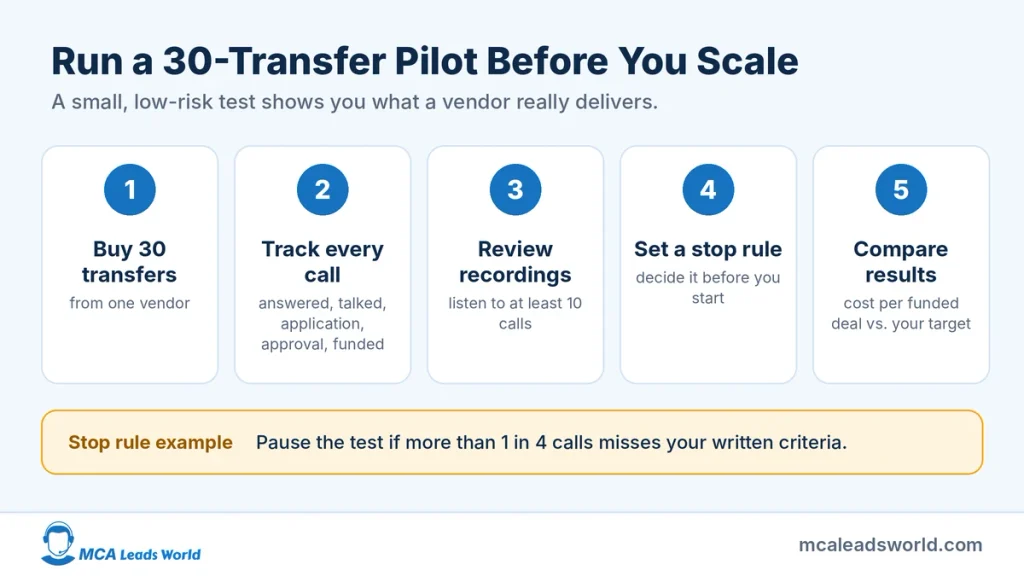
Start small. Here’s a simple plan:
- Buy 30 transfers from one vendor.
- Track each call in a simple sheet: answered, talked, application, approval, funded.
- Review recordings for at least 10 calls.
- Set a stop rule before you start. For example, pause if more than one in four calls fails your written criteria.
- Compare your cost per funded deal with your target.
Then run the same pilot with a second vendor and compare the results.
KPIs to Track for MCA Live Transfers
You can’t improve what you don’t measure. Track these numbers by vendor, by hour of day and by closer:
| KPI | How to calculate it |
| Answer rate | Answered transfers ÷ total transfers |
| Average talk time | Total talk minutes ÷ answered calls |
| Application rate | Applications ÷ real conversations |
| Approval rate | Approved deals ÷ applications |
| Funding rate | Funded deals ÷ approved deals |
| Cost per funded deal | Total spend ÷ funded deals |
Review the numbers every week. Over time, patterns will show which vendors, hours and reps perform best.
Why Choose MCA Leads World for MCA Live Transfers?
We’re MCA Leads World, an MCA leads provider serving funders across the United States. If you want to test MCA live transfers, ask us the same 10 questions from this guide. Any vendor, including us, should answer them clearly.
Ready to start small? Contact us to request a live transfer test batch. You can also browse more funding guides on our blog.
MCA Live Transfer FAQ
What is an MCA live transfer?
An MCA live transfer is a phone call where an agent screens a business owner who wants funding and then connects the live call to your rep. You talk to the owner in real time, so you skip cold dialing and list chasing.
How much does an MCA live transfer cost?
Published prices run from about $30 to $200 or more per transfer. Filters, exclusivity, location and volume all change the price. The better number to watch is your cost per funded deal, which equals total spend divided by funded deals.
How fast do I need to answer an MCA live transfer?
Aim for 10 to 15 seconds. Owners hang up fast, and you may still pay for the call. A dedicated phone line and clear call rules help your team answer in time.
Are MCA live transfers exclusive?
Not always. Some vendors sell each transfer to one funder, while others share them. Get the exclusivity promise in your contract, then test it by asking owners whether other funders have called.
Are MCA live transfers TCPA compliant?
It depends on the vendor’s process. Ask how they get consent, scrub Do Not Call lists and store recordings. B2B calls get more flexibility, but a business owner’s personal cell phone can still create risk. Check with a lawyer.
What’s the difference between a live transfer and an appointment?
A live transfer connects the owner to your rep during the call. An appointment books a time for a later call. Live transfers are faster, while appointments suit teams that want planned conversations.
How many MCA live transfers should I buy to test a vendor?
Start with about 30. That’s enough to see answer rates, call quality and early conversions without a big bill. Review recordings, track every result and compare your cost per funded deal.
Do live transfers work for unsecured loans and equipment financing?
Yes, if the vendor matches your criteria. Some vendors sell a business loan leads live transfer for term loans or equipment deals. Ask for filters such as funding amount, use of funds and credit range, so the owner fits your product.